
7 Steps to Find Tested Research Peptides You Can Trust
Last Updated: November 18, 2026
Quick Summary
To find tested research peptides you can trust, match the certificate of analysis to the exact batch number on your vial and confirm the testing laboratory is real and independent. Check that the report lists HPLC and mass spectrometry methods, and request the raw chromatogram as evidence.
- A certificate of analysis reports what a batch contains and how pure it is, not its safety or effectiveness.
- The COA must reference the same lot number printed on the vial label.
- Purity is typically measured by HPLC and identity confirmed by mass spectrometry.
- Ask for the underlying HPLC trace and mass spectrum, not just the summary page.
- Cross-border shipments into Canada pass through the CBSA and may face customs holds.
Table of Contents
- What Tested Research Peptides Actually Prove
- How to Verify Peptide Lab Results Before You Buy
- Reading a Peptide Certificate of Analysis Line by Line
- Research Peptide Shipping and Customs Into Canada
- Frequently Asked Questions
What Tested Research Peptides Actually Prove
Third-party testing confirms identity and purity of the compound inside the vial, not its safety or effectiveness in humans. A certificate of analysis is the starting point for evaluating where to buy tested research peptides, not the finish line.
A certificate of analysis (COA) is a document from an independent laboratory reporting what a specific batch contains and how pure it is. It typically lists the compound name, batch number, test method, and purity percentage.
What a COA does not tell you:
- Whether the peptide is sterile or free of heavy metals
- Whether the vendor tested the vial you will actually receive
- Whether the product is legal to import
Testing proves the vial matches its label. Nothing more.
How to Verify Peptide Lab Results Before You Buy
Verification starts with the batch number. Ask the supplier for the COA tied to the exact lot you are ordering, then check it independently.
Step 1, Match the batch, not the product. The COA must reference the same lot number printed on the vial label. A certificate covering a product line rather than a single batch tells you nothing about your vial.
Step 2, Confirm the laboratory is real and independent. Look up the lab named on the report. A legitimate third-party laboratory will have a verifiable business presence, a contact channel, and a stated scope of testing. A lab that exists only as a logo on a PDF, or shares an address or domain with the supplier, is not independent.
Step 3, Check the report date against the batch date. A COA should be dated after the batch was manufactured and close to the lot you are buying. An undated report, or one dated years before the current batch, cannot establish anything about your vial.
Step 4, Read the methods, not just the result. Purity is typically measured by HPLC (high-performance liquid chromatography), and identity is typically confirmed by mass spectrometry. A purity percentage with no method attached is a number without a basis.
Step 5, Request the raw chromatogram. The summary page is a conclusion; the chromatogram is the evidence. Ask for the underlying HPLC trace and the mass spectrum.
Step 6, Confirm the sample identity chain. The report should describe the sample as received, its appearance, labeled identity, and batch, so you can trace the tested material to the vial. If the sample cannot be linked to your lot, the result does not transfer.
A purity result confirms the share of the target compound in the tested sample; it does not confirm sterility, the absence of heavy metals or residual solvents, endotoxin levels, or suitability for any human use. Those require separate assays that most research-peptide COAs do not include.
You can review the actual lab results we publish for each batch before ordering.
Reading a Peptide Certificate of Analysis Line by Line
Most buyers skim a COA and stop at the purity number. The details around it carry equal weight.
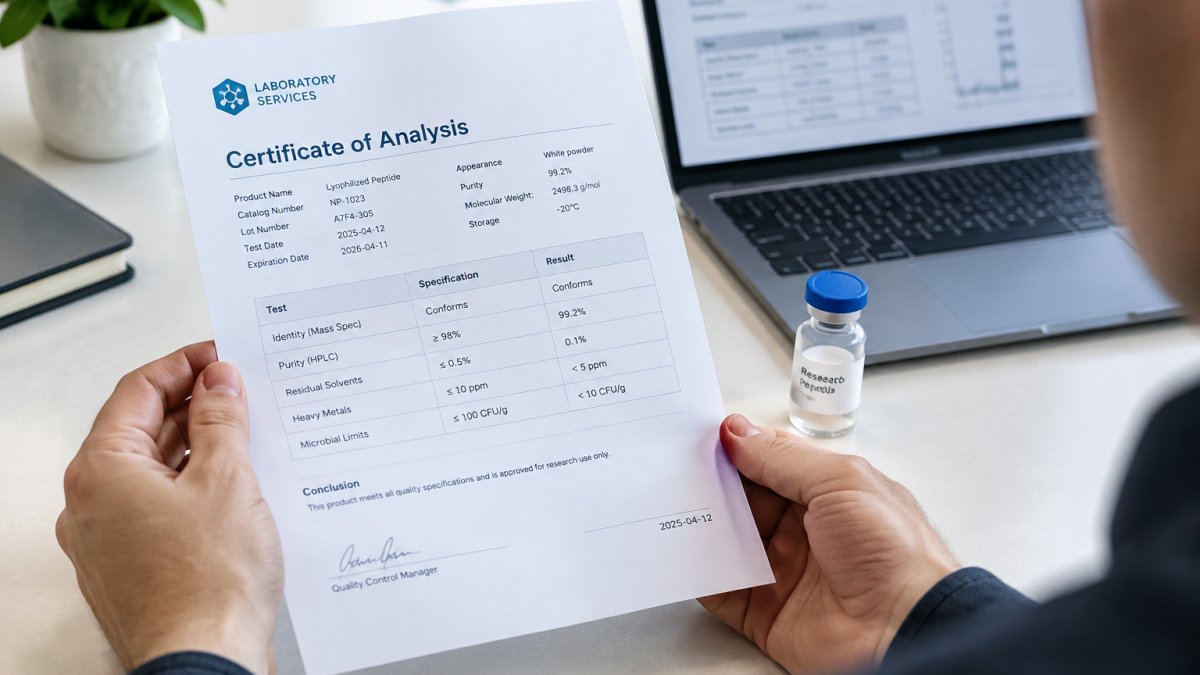
| COA Field | What It Confirms | What to Check |
|---|---|---|
| Batch number | Traceability to your vial | Matches the label exactly |
| Test method | How purity was measured | HPLC and mass spec listed |
| Purity percentage | Share of the target compound | Consistent with the claim |
| Testing laboratory | Who ran the analysis | Independent, named lab |
| Raw data | Underlying chromatogram | Available on request |
If a line is missing or vague, ask. You can also browse our tested peptides to see how batch documentation is presented. For follow-up questions about certificates and testing, the FAQ covers the details buyers ask about most.
Research Peptide Shipping and Customs Into Canada
Shipping into Canada brings variables that domestic suppliers handle differently from international ones. Delivery timelines and customs handling depend on the supplier and the carrier, so confirm both before you order.
Carrier and fulfillment. Cross-border shipments pass through the Canada Border Services Agency (CBSA), and shipments may be subject to applicable federal rules. Ask which carrier the supplier uses, whether the shipment originates domestically or abroad, and whether tracking is provided end to end.
Temperature control and packaging. Many research peptides are shipped with cold packs or insulated packaging to limit heat exposure in transit. Ask whether the shipment includes temperature control, how long the cold chain holds, and how the vial is protected from light and damage.
Landed cost, not sticker price. Confirm whether shipping is included, whether duties or taxes apply on cross-border orders, and whether the supplier covers or passes through brokerage fees. A lower sticker price with added fees can cost more than a higher-priced domestic option.
Customs holds and seizures. A package held at customs can delay delivery by weeks, and seized shipments may not be refundable depending on the supplier’s terms. Read the shipping and refund policies before checkout, and ask what the supplier does if a shipment is held, returned, or seized, replacement, refund, or nothing.
Storage on arrival. Lyophilized peptides should be stored cold and protected from light and moisture, with reconstituted material handled per the supplier’s instructions. Confirm the supplier’s stated storage conditions and follow them.
We publish our delivery timelines and customs details so you know what to expect, and our refund terms explain what happens if a shipment is delayed or seized.
Sourcing research peptides with confidence comes down to documentation you can check yourself. NextGen Health provides 100% independent third-party HPLC and Mass Spec certification, batch traceability on every vial, and discreet shipping, all backed by the Milligram app for logging your protocols. Get started with NextGen Health and order with verified batch records in hand.
Frequently Asked Questions
Where can researchers buy tested research peptides?
Look for suppliers who publish batch-specific third-party HPLC and mass spectrometry reports and let you match the batch number on the report to the vial you receive. NextGen Health provides independent third-party HPLC and mass spec certification with batch traceability, so you can review the results for the exact batch you are ordering rather than a generic certificate. Always confirm the report is dated, names the testing laboratory, and covers the compound and quantity on the label before you order.
How can you verify a research peptide supplier’s test results?
Ask for the certificate of analysis for the specific batch you would receive, then check that the batch number on the report matches the vial label. Confirm the report includes the testing method (HPLC and mass spectrometry), the purity percentage, the measured mass, and the name of the independent laboratory. Where possible, contact the laboratory directly to confirm the report is genuine. A supplier who cannot produce a batch-matched report, or who only shares a generic certificate, has not shown you evidence for the product in your hands.
Can research peptides be shipped across borders?
Cross-border shipping depends on the destination’s import rules, and clearance is never guaranteed. Shipments into Canada can be held or refused by the Canada Border Services Agency, . Before ordering, ask the supplier how they pack lyophilized powder, whether they provide tracking, and how they handle a parcel that arrives damaged or delayed. Check the current import requirements with the Canada Border Services Agency and Health Canada, since rules change and a supplier’s shipping page is not a legal source.
