
NEUROSCIENCE & COGNITIVE RESEARCH
Semax
10 mg
Supports Focus, Memory & Neuroprotection.
Semax is a synthetic ACTH (4-7) analog neuropeptide studied for its potential to support cognitive function, neuroplasticity and brain health. This product is intended for research purposes only.
A Healthier Tomorrow
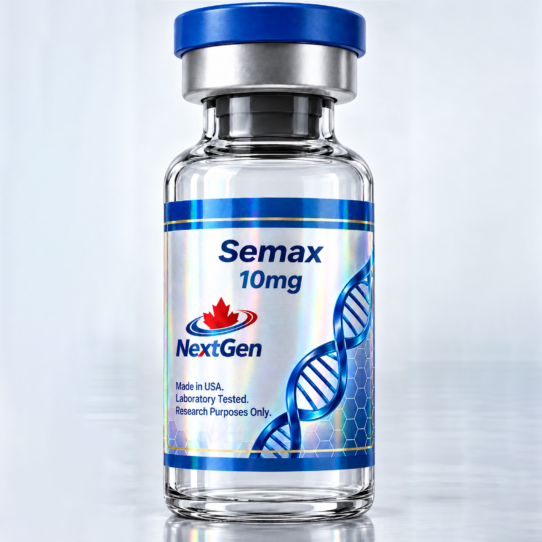
Semax
10 mg
$90.00 — or $90.00 Original price was: $90.00.$81.00Current price is: $81.00. / month
Ships within 1-2 Business Days
Subscribe monthly and save 10%
- Ship to Canada,USA & Mexico
- Secure Checkout
- Add to wishlist

PREMIUM QUALITY:
Pharmaceutical-grade

INDEPENDENT TESTING:
Quality verification

BATCH TRANSPARENCY:
Product information

GLOBAL ACCESS:
Canada, USA & Mexico
SUPPORTING A HEALTHIER YOU
Research Today. Real Possibilities.
Semax is a synthetic ACTH (4-7) analog neuropeptide that has been studied for its potential role in cognitive enhancement, neuroprotection and neural signaling. This product is intended for researchers exploring its potential in preclinical and clinical models.
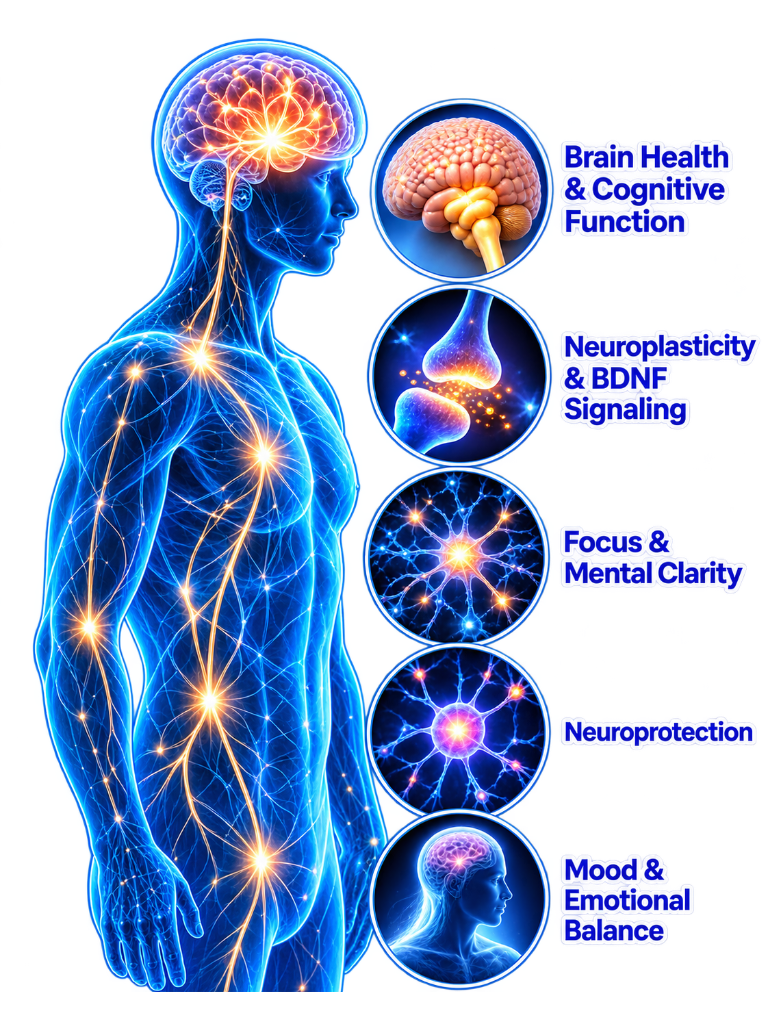
- Supports cognitive function (research)
- Studied for memory and learning (research)
- Explored for neuroprotection (research)
- Supports neuroplasticity and BDNF signaling (research)
- Investigated for focus, mood and mental clarity (research)
KEY AREAS OF HUMAN
KEY AREAS OF HUMAN

The Science
Evidence & Mechanism
Semax (ACTH 4-7) is a synthetic neuropeptide that has been studied for its potential to modulate neurotransmitter systems, support BDNF expression, and enhance neuroplasticity. Research suggests it may support cognitive function, neuroprotection and stress resilience through multiple pathways, including dopaminergic and glutamatergic signaling. Human clinical evidence is limited, and it is primarily studied in preclinical models.
May influence dopamine and glutamate systems.
Investigated for its ability to support neuroplasticity and learning.
Explored for potential neuroprotective effects in preclinical models.
Studied for its role in supporting stress resilience and cognitive performance.
Product Information
| Product Name | Semax |
| Common Name | ACTH (4-7) analog |
| Total Strength | 10 mg (lyophilized) |
| Vial Size | 3 mL |
| Purity | > 99% (HPLC) |
| Product Format | Lyophilized powder |
| Storage | Store refrigerated (2°C–8°C). Protect from light and moisture. |
| Intended Use | Research use only. Not approved for human use. |
Why Choose Nextgen
- Premium quality research products
- Independent laboratory testing
- Batch transparency
- Consistent quality standards
- Milligram App integration
- Dedicated customer support

FREQUENTLY ASKED QUESTIONS
Your Questions, Answered.
Find quick answers to common questions about this Product.
Semax has been investigated for effects on neurotrophins, proteins involved in nerve-cell function. Rat studies measured changes in BDNF-related signalling and learning behaviour. These experiments provide a reason to study nervous-system effects, but they do not establish sharper focus, better memory or protection against neurological disease in healthy people.
A study in people recovering from ischemic stroke examined Semax alongside rehabilitation and reported changes in BDNF and functional scores. Stroke recovery is a specific clinical setting, and the study’s design limits how strongly the effect can be attributed to Semax. These findings should not be repackaged as a general cognitive-enhancement benefit.
Selank has a separate research history involving anxiety symptoms. Its results do not validate Semax, and findings for either peptide cannot demonstrate that a combined product improves both mood and focus. Readers should look for the exact compound, study population, comparison group and measured outcome before interpreting a benefit claim.
Selank has small human studies on anxiety symptoms, while Semax has laboratory neurotrophin research and limited studies in stroke rehabilitation. These are separate evidence bases. They explain interest in a combination, but do not establish that the listed Selank plus Semax blend improves both mood and focus, or provides a broader cognitive benefit.
A result for either ingredient alone cannot determine the effect of a mixture. The blend could differ in absorption, stability, tolerability or clinical response. Demonstrating an advantage requires direct comparison of the exact formulation with its components and a control. DSIP’s separate, mixed sleep findings do not add evidence that this blend improves sleep.